 Sandra Chrust
The starting point
When I joined UnifyApps, the company had HubSpot Sales Hub, Apollo, an active LinkedIn presence, a small platform-focused website, a draft white paper and pre-purchased industry events. Marketing campaigns, formal tracking and reporting, an established ICP and consistent event follow-up had yet to be built.
My mandate was to build the marketing function, establish the U.S. presence and European presence, while expanding our footprint in the Middle East and India to generate qualified pipeline. An initial field marketing objective was 10× the investment in qualified pipeline.
Finding the right people
We formalized an ideal customer profile and looked for signs of AI initiatives and leadership. The focus included CIOs, CFOs, chief data and AI officers, and business leaders at target accounts—including organizations in manufacturing, supply chain, consumer goods, banking and financial services.
We built an owned-events strategy alongside selected third-party conferences, giving us greater control over the audiences and experiences we created.
Experiences with purpose
Signature Events brought executives together for structured dinners or lunches with speakers, panels or fireside conversations and networking.
Agent workshops gave practitioners sandbox access to build agents during a hands-on half-day session.
Customer hackathons brought technical teams together to build applications and explore additional use cases.
“One of us who attended the event would follow up personally with attendees to increase the chance of setting up a post-event meeting.”
Repeatable by design
We created runbooks for each event type: structured checklists and how-to guides covering planning, execution and follow-up. Partnering closely with BDRs, we established a white-glove approach in which one of us who attended the event would follow up personally with attendees to increase the chance of setting up a post-event meeting.
One event. Three connected tools.
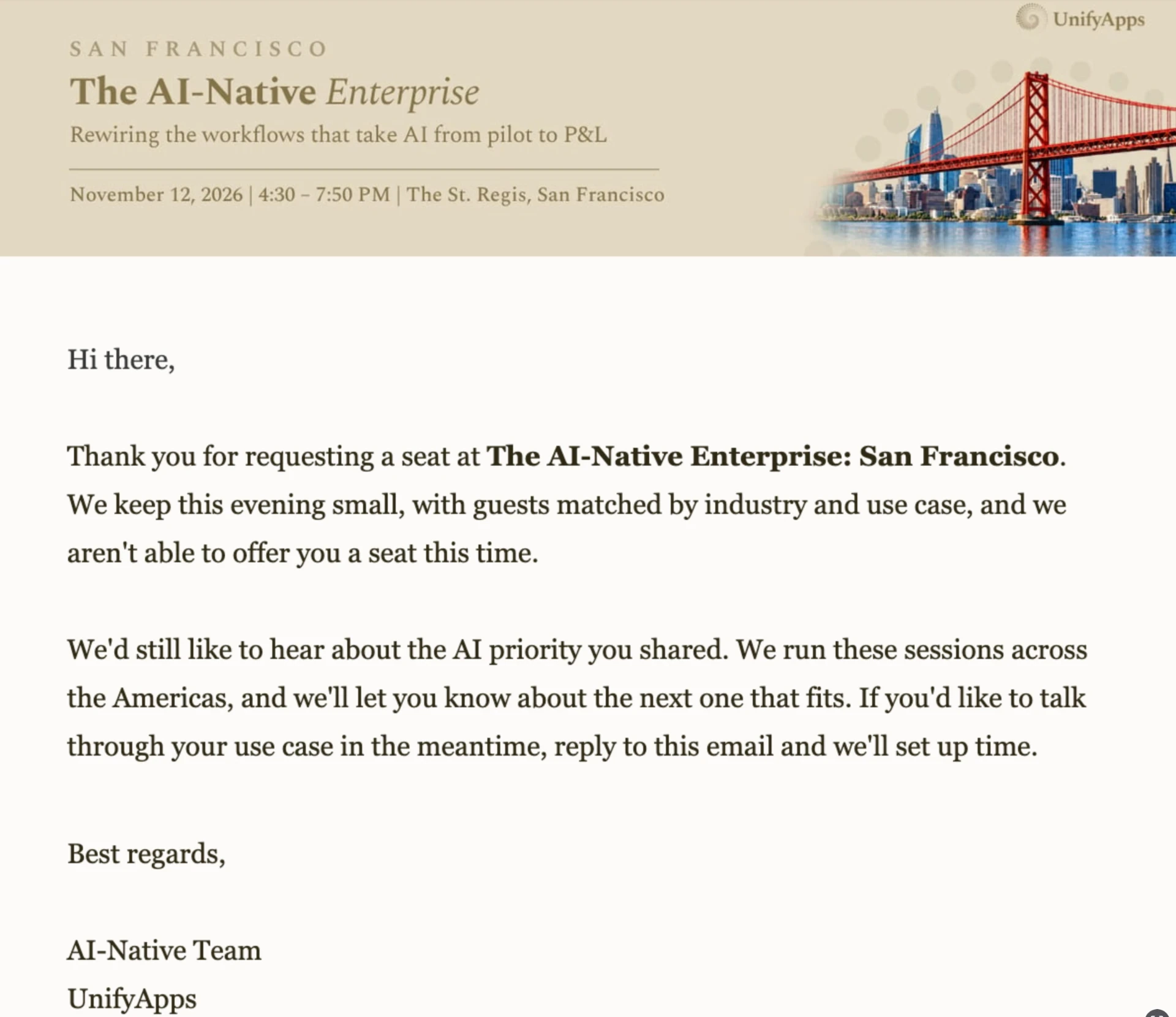
The invitation, event page and runbook make each executive event consistent, personal and easier to repeat.
Invitation email
A personal response keeps the conversation going, even when the event cannot offer a seat.
- Clear event positioning and details
- Guest matching by industry and use case
- A direct route to continue the conversation
 Open full-size image
Connecting investment to opportunity
We tracked contact sources and event names, associated contacts with opportunities and used a 180-day lookback to understand marketing’s contribution. Deal source and partner associations gave us a way to consider marketing and partner involvement together.
The target was 6–10× the event investment in qualified pipeline. A $50,000 event, for example, would target $300,000–$500,000 in qualified pipeline.
Regional events delivered 4.8x: $8.3M pipeline on $1.71M regional event spend. Owned Middle East and India events returned 11–21x.
Cohort analysis showed that much of the qualified pipeline associated with events emerged in the following quarter and the one after, helping the business plan ahead.
Learning and adapting
Owned executive events showed strong results in the Middle East. A relationship established at Ai4 Las Vegas led to a customer within 30 days. We continued evaluating each conference against its audience, investment and contribution to qualified pipeline.
Small executive rooms outperformed big conference booths: owned dinners in the Middle East produced about $10K of pipeline per contact, against under $300 at large paid conferences, so I shifted the mix toward owned executive formats and made partner co-hosting the default, including $300K of AWS co-marketing funds.
Leadership and team
I owned the budget and event mix and remained hands-on across planning, selected trade shows, copy, landing pages, follow-up, runbooks and rebrand execution. In close partnership with the field marketing team, we reviewed results and worked to improve data quality.
A team of three field marketers recently reached a pace of roughly one or more events per week.
AI-native execution
I designed a five-stage, 35-step Content Factory: an agentic workflow that turns market signals into drafts. People make 7 of the 35 decisions, including sign-off on every claim.
A Claude skill for sellers creates on-brand decks and ABM assets on demand, trained on brand voice, messaging and approved customer proof.
For speed to market, we built Lovable-to-Vercel/Contentstack landing pages for events and campaigns, and connected Claude to HubSpot for reporting.
Results
Marketing overall sourced $19.4M of qualified new-business pipeline, the #1 source, in FY27 Q1–Q3 (Feb 1–Oct 31, 2026) under first-touch attribution. This is an overall marketing result.